Vercel Releases UI SDK for Agents to Compose UI from Reusable Behaviors
Vercel released UI SDK 0.1.0-beta.1, an open-source TypeScript library providing over 50 reusable behaviors and an agent bridge across five frameworks.
By Dillip Chowdary • Nov 18, 2026 • Source: InfoQ
At a glance
- Product
- Vercel UI SDK
- Version
- 0.1.0-beta.1
- License
- Apache License 2.0
- Release date
- November 18, 2026
- Availability
- Public beta on GitHub vercel-labs/ui
- Core peer limits
- React 19+, Vue 3.5, Svelte 5.33, Solid 2.0.0-rc.14
Vercel has released UI SDK in public beta, an open-source TypeScript library designed to decouple essential user interface interactions from rendered markup. According to InfoQ's report, the project is published on GitHub under vercel-labs/ui and provides core interface primitives that software engineers and autonomous AI agents can assemble across multiple web frameworks. Rather than burying focus, selection, and keyboard mechanics inside monolithic widgets, the library isolates these mechanisms into modular primitives.
This breakdown details the architecture of @ui-sdk/core, its multi-framework adapter layer, the programmatic agent bridge, and community analysis from frontend engineers. The guide is intended for frontend architects, full-stack developers, and AI engineers constructing agentic interfaces who require accessible, cross-framework component infrastructure without being locked into a single rendering ecosystem.
01Reusable behaviors and primitive definition
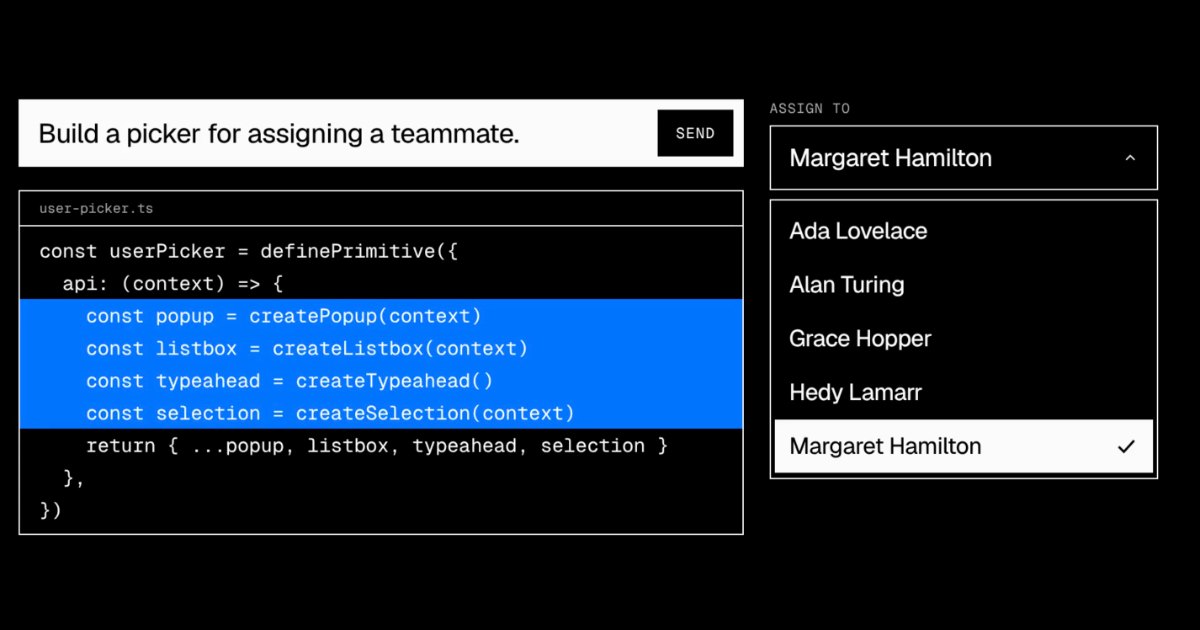
The foundation of the library resides within @ui-sdk/core, which extracts interactive web mechanics into more than 50 isolated behavior functions. Instead of hardcoding keyboard navigation, focus restoration, selection logic, popups, and drag-and-drop management inside monolithic components, the package exposes them as standalone helpers. Key modules include createPopup, createSelection, createTypeahead, createRovingFocus, createReorder, createResize, createViewport, createListbox, createChange, createFocusRecovery, and createVirtualizer.
Developers and autonomous coding agents combine these primitives inside definePrimitive to establish a component contract in a single definition. This declaration specifies the component state, external API methods, and available rendering slots without coupling the logic to any specific frontend framework. The resulting primitive standardizes behavioral state management while remaining completely detached from presentation styling and document structure.
02Unstyled starter components and adapters
Framework adapters translate primitive contracts into rendered elements using the createParts function across React, Vue, Svelte, Solid, and Web Components. Because the runtime outputs unstyled elements, each part directly exposes DOM attributes and custom CSS variables for design systems to target. This unified architecture ensures that teams maintain consistent component APIs and part names regardless of the underlying view layer chosen.
Vercel bundled an unstyled starter catalog containing more than 50 prebuilt components constructed on top of these core behaviors. The collection includes complex interactive controls such as Color Picker, Token Input, Command, Calendar, Tree, and OTP Input widgets. Every component across all five supported framework adapters shares identical slot names and programmatic properties, allowing design tokens and accessibility patterns to remain identical across multi-framework codebases.
03Agent bridge and browser runtime tools
The library includes a dedicated bridge that enables autonomous agents to operate user interfaces directly at runtime rather than relying on computer vision screenshots. By importing createAgent from an adapter package such as @ui-sdk/react/agent, applications grant agents access to snapshot, act, and query methods. These tools read live state structures and invoke component actions through native software APIs instead of simulating fragile mouse clicks.
Advertisement
Tech Pulse Daily
Get tomorrow's pulse first
Join engineers who read Tech Pulse before stand-up. Free, weekday mornings.
Host applications retain strict supervisory control over agent interactions through contextual callback mechanisms. Whenever an agent triggers a component update, change callbacks receive an event payload with details.source set to agent, allowing developers to inspect or cancel unauthorized mutations programmatically. Furthermore, the registerTools helper can expose these controls directly to browser agents through WebMCP when browsers provide a document.modelContext interface.
Developer tooling integrates directly with agent environments through an installable skill that directs models to local documentation: ``bash npx skills add vercel-labs/ui --skill ui-sdk `` This configuration indexes the Markdown specifications distributed within the packages, teaching code-generation models the exact properties, behaviors, and slot arrangements supported by the system.
04Headless ecosystem and architectural layers
The frontend ecosystem already offers established headless solutions including Radix UI, Base UI, React Aria, Ark UI with Zag.js state machines, and Headless UI. While shadcn/ui operates one layer higher as a copy-paste component kit, UI SDK targets a lower layer by standardizing cross-framework behaviors and embedding native agent bridges. The project changelog specifically acknowledges Radix, Base UI, React Aria, shadcn/ui, Nuxt UI, and Geist.
| Library | Architectural layer | Multi-framework support | Agent bridge support | | UI SDK | Composable behaviors in core | React, Vue, Svelte, Solid, Web Components | Built-in snapshot, act, query tools | | shadcn/ui | Copy-into-repo component kit | Framework-specific kits | None | | Radix UI | Headless component primitives | React-focused | None | | Base UI | Headless component primitives | React-focused | None | | Ark UI | Zag.js state machine primitives | Multi-framework | None |
Community engineers highlighted both the novel agent capabilities and the architectural shifts introduced by the package. Rahim, a product engineer at Mux who created Vidstack, praised the createAgent bridge for allowing direct component interaction alongside cancelable change callbacks. Meanwhile, a developer identified as Stefan questioned the concrete value proposition compared to Base UI, asking whether teams should conceptualize interfaces primarily as combinations of behaviors.
Vercel has not disclosed whether its popular shadcn/ui distribution will eventually be rebuilt on top of UI SDK primitives. The core maintainers have positioned the codebase as a foundational layer rather than an immediate visual replacement for existing design kits. For now, engineers can adopt the primitives independently while evaluating how behavior-driven composition affects long-term application maintenance.
05Framework peer dependencies and beta installation
Adopting the library requires installing the shared core engine alongside the appropriate framework adapter package: ``bash npm install @ui-sdk/react @ui-sdk/core `` This installation grants access to the underlying behavior modules and framework-specific bindings. Production setups require modern framework runtimes, with the React adapter mandating React 19 or later to support its rendering primitives and asynchronous features.
Alternative view libraries require strict peer dependency ranges documented across the adapter specifications. The Vue package targets Vue 3.5, the Svelte integration requires Svelte 5.33, and the Solid adapter specifies Solid 2 starting from version 2.0.0-rc.14. Web Components implementations operate without external framework runtimes, providing standards-compliant custom element wrappers around the shared behavior engine.
Note: Vercel distributes UI SDK version 0.1.0-beta.1 under the Apache License 2.0, governed by Vercel's standard public beta terms. Engineering teams should recognize that interface signatures, documentation references, and runtime behaviors remain experimental and subject to breaking modifications before the library reaches general availability.
Frequently asked questions
What is Vercel UI SDK?
Vercel UI SDK is an open-source TypeScript library that packages more than 50 user interface behaviors into reusable primitives. It allows developers and autonomous AI agents to compose accessible components across React, Vue, Svelte, Solid, and Web Components.
How do AI agents interact with components in UI SDK?
Through the createAgent runtime bridge, agents can read component state and invoke actions via snapshot, act, and query tools without using screenshots. Applications can inspect event sources and cancel agent-initiated changes when necessary.
Which frontend frameworks does UI SDK support?
UI SDK provides adapters for React 19 or later, Vue 3.5, Svelte 5.33, Solid 2 from 2.0.0-rc.14, and native Web Components. All adapters share identical behavior logic, slot names, and unstyled component parts.
How does UI SDK differ from existing headless libraries like Radix UI or Base UI?
UI SDK operates at a lower architectural layer by isolating discrete behaviors like focus recovery and selection rather than whole components, sharing them across five framework ecosystems. It also includes built-in agent bridges and WebMCP tool registration.
Sources

Author
Dillip Chowdary
Writes Tech Bytes coverage of AI, engineering, and the tools that actually ship. Editor of Tech Pulse Daily.
Related on Tech Bytes
Advertisement