Quota Boss – get more done per Claude limit with the plans you have
Quota Boss routes coding sub-tasks across existing subscriptions to cut Claude usage by 29 percent on large tasks while monitoring active limits live.
By Dillip Chowdary • Nov 18, 2026 • Source: github.com
At a glance
- Product
- Quota Boss
- Availability
- Public open source on GitHub
- Installation
- Node.js 18 or newer via npx
- Primary limit
- Claude 5-hour and weekly quotas
- Secondary model
- Codex CLI with ChatGPT subscription
- Savings metric
- Up to 29 percent less Claude usage
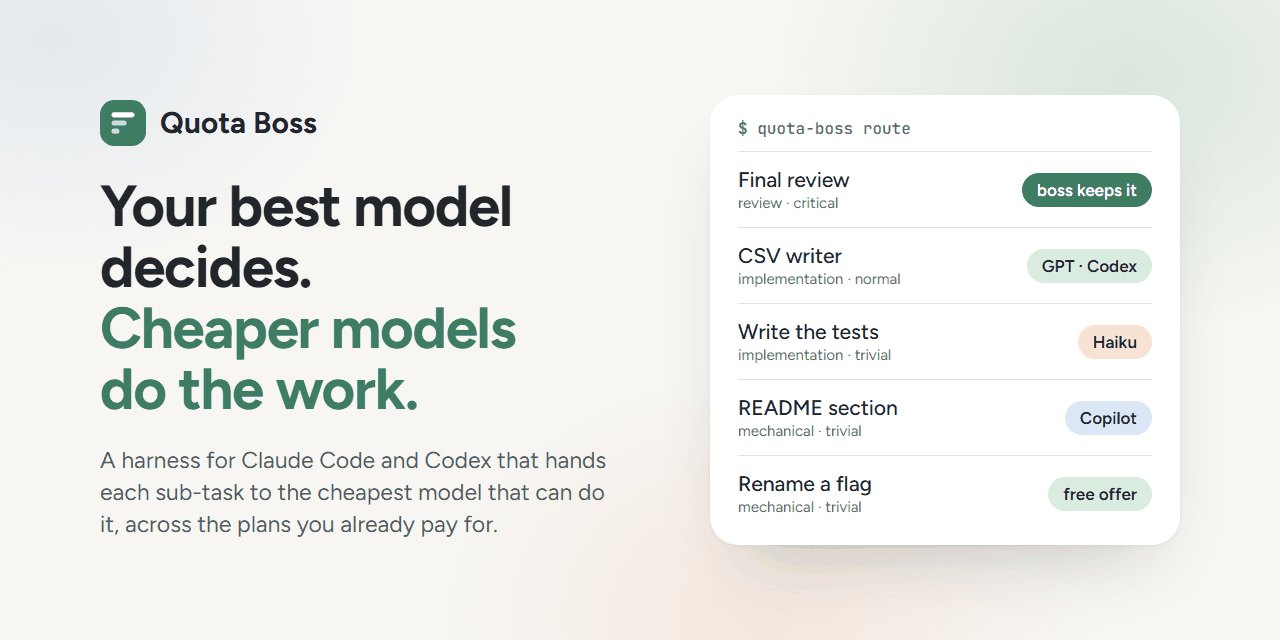
Open-source developer CrazyToto released Quota Boss, an orchestration harness designed to manage rate limits across coding assistants including Claude Code and the Codex command-line interface. The system acts as a coordinator that routes sub-tasks to the most cost-effective model across paid subscriptions and designated free offerings. According to github.com's report, the harness preserves primary model allowances by delegating routine implementation to secondary services while monitoring five-hour and weekly quotas directly on screen.
This report details the architectural design, routing formula, benchmark savings, supported provider subscriptions, and credential protections built into the platform. Software engineers, autonomous system developers, and technical leads managing multi-seat coding subscriptions can use this breakdown to evaluate workload distribution strategies. The coverage explains how developer environments dynamically balance task importance against remaining provider allowances during heavy software construction cycles.
01Command line setup and project activation
The orchestrator requires Node.js 18 or newer alongside an active Claude plan and Claude Code installation. Developers can deploy the tool across Windows, macOS, and Linux using npx quota-boss@latest, npm install -g quota-boss, or direct repository compilation. An optional dry-run flag previews system adjustments, automatic backups preserve existing Claude settings, and a dedicated uninstall command cleans files entirely.
- Setup run Type /boss-setup inside Claude Code to initiate a terminal walkthrough covering active subscriptions and free tiers before confirming adjustments.
- Project activation Type /boss on with a chosen quality, balanced, or frugal profile to enable routing on target repositories without affecting others.
- Task execution Develop software normally while the coordinator partitions incoming assignments, routes components to selected models, and reports worker actions.
Developers configure workspaces using native slash commands like /boss status, /boss route, /boss settings, and /handoff to preserve project context across fresh sessions. The repository also supplies terminal utilities including quota-boss savings, quota-boss route --explain, and quota-boss doctor to troubleshoot installations without spending quota. The diagnostic doctor command reports issues alongside targeted fixes, while an optional reporting flag exports sanitised configuration logs.
02Worker delegation hierarchy and utility scoring
The architecture designates Claude Opus as the primary boss tasked with planning, classifying, delegating, and verifying code changes across connected model agents. Subordinate workers include codex-worker running GPT-6.1-Sol with medium reasoning effort for testing, sonnet-worker for substantial code implementation, and haiku-worker for minor documentation edits. Specialized sub-agents like scout and Explore leverage Haiku for codebase search, while dedicated reviewer instances examine pull request diffs.
Every user prompt displays real-time five-hour and weekly usage percentages alongside active profile states for connected accounts like Claude and Codex. Sub-tasks receive an operational tier spanning critical, normal, or trivial classifications alongside categories including architecture, debugging, implementation, review, research, and mechanical tasks. Routing decisions calculate candidate viability using the formula utility = P(success) ^ alpha(tier, profile) / ( cost × quota price ).
Success probability values update dynamically as the primary coordinator verifies completed assignments, with recorded worker failures penalized double during candidate scoring. The quota price component increases as individual subscriptions approach rate limits and decreases when excess quota nears reset cycles unused. When task checks fail, the system increases reasoning effort on that worker before escalating the job to a higher tier model.
Advertisement
Tech Pulse Daily
Get tomorrow's pulse first
Join engineers who read Tech Pulse before stand-up. Free, weekday mornings.
03Benchmark allocation savings and token measurements
Controlled benchmarks show that task delegation delivers the largest efficiency gains when a developer's primary five-hour Claude allowance reaches seventy-five percent exhaustion. When evaluating large software tasks under heavy quota usage, assigning build operations to Codex reduced Claude consumption by approximately one-third while matching all hidden verification tests. The delegated workflow required roughly twice as long to complete due to secondary model build coordination.
| Task Evaluation Category | Benchmark Result and Resource Impact |
|---|---|
| Large task benchmark (75% quota used) | Used one-third less Claude for identical hidden test results; execution time doubled under Codex builds |
| Medium task benchmark (75% quota used) | Saved no Claude allowance during testing; orchestrator now retains tasks of this scope locally |
| Read-heavy task benchmark (surplus quota) | Orchestrator retained jobs locally; resource cost matched baseline within minus 2% to plus 3% |
| Document query benchmark (80 KB manual) | Reduced Claude consumption by 10% with identical answers; took 20 seconds longer by reading selective sections |
| Codex orchestrator benchmark | Incurred no additional cost across varying task sizes while achieving identical test results |
Delegation on medium-sized assignments failed to conserve Claude allowances, leading the orchestrator to retain tasks of that size within the main model. Real-world telemetry collected across nine days of active repository development showed that auxiliary workers handled fourteen percent of assigned workloads. That distribution produced an estimated twenty-nine percent reduction in Claude consumption, providing roughly 1.4 times more completed work per subscription cycle.
04Connected subscription catalog and free model tiers
The platform connects with existing developer subscriptions across Claude, ChatGPT, GitHub Copilot, Grok, and Google Antigravity using official provider command-line binaries. Claude and Codex CLI workflows are tested end to end, whereas Copilot and Antigravity connectors are compiled directly from vendor technical documentation. Unverified integrations like Grok remain turned off until users enable them, and Perplexity Pro research prompts copy directly to the terminal clipboard.
| Subscription Category | Supported Platforms | Operational Method |
|---|---|---|
| Paid Subscriptions | Claude, ChatGPT Codex, GitHub Copilot, Grok, Google Antigravity | Official provider command-line tools authenticated directly by user |
| Research Tools | Perplexity Pro | Clipboard prompt generation with return via slash command |
| Free API Offers | Mistral, OpenRouter, Cloudflare, Cohere, Gemini, NVIDIA, Z.ai | Opt-in API connections displaying individual limits and data warnings |
| Local Models | Ollama framework | Local model execution configured via slash command |
Note: Google Antigravity integrations carry an account warning due to vendor terms, and certain free API offers train models on submitted data. Providers maintain distinct service agreements that change over time, requiring developers to inspect published terms before activating external connections.
05Zero credential storage and local diagnostic safety
The security architecture enforces zero credential retention by never accessing user API keys, session tokens, or browser cookies on the host machine. Network communication occurs exclusively through official provider command-line binaries signed in as the developer, while custom API keys remain inside external tools like OpenCode. Local models run entirely on user hardware via Ollama integrations, ensuring proprietary source code remains isolated within local machine boundaries.
The utility contains zero external npm dependencies and runs purely on Node.js across standard desktop operating systems. The built-in doctor command inspects local configurations and details targeted remediation steps without expending provider token allowances. When developers generate troubleshooting reports, the output includes runtime versions, provider availability, self-test results, and failure counts while excluding file paths, user identities, and secret keys.
Frequently asked questions
What dependencies does Quota Boss require to run?
Quota Boss requires Node.js 18 or newer alongside Claude Code and an active Claude plan. The Codex CLI with a ChatGPT subscription is recommended for delegating implementation workloads.
How does Quota Boss decide which model handles a task?
The tool scores models using an algorithm that weighs success probability, task category, tier importance, execution cost, and remaining quota price. Critical tasks go to higher-tier models, while trivial jobs route to cheaper subscriptions.
Does Quota Boss access or store private API keys?
No, Quota Boss never reads private authentication keys, session tokens, or browser cookies. All model interactions occur through official provider command-line tools authenticated directly by the user.
What level of Claude usage reduction does the tool achieve?
Benchmarks indicate a one-third reduction in Claude usage on large tasks with a 75 percent utilized limit, and nine-day real-world testing demonstrated a 29 percent savings.
Sources

Author
Dillip Chowdary
Writes Tech Bytes coverage of AI, engineering, and the tools that actually ship. Editor of Tech Pulse Daily.
Related on Tech Bytes
Advertisement